
The case against locking in
A lesson in letting go of things that used to serve us but don't anymore

I’m a planning freak, and I love it.
I love setting ambitious goals and hauling ass to make them happen. Every weekend, I look at my schedule for the following week and plan my priorities against my calendar to make sure I can get everything done. These rituals are a core part of my identity, so much so that I’ve helped other friends organize their lives.
Case in point, here’s a week in my life, featuring my Google calendar. This might feel scary for some, but to me, this is just a normal week in the life:
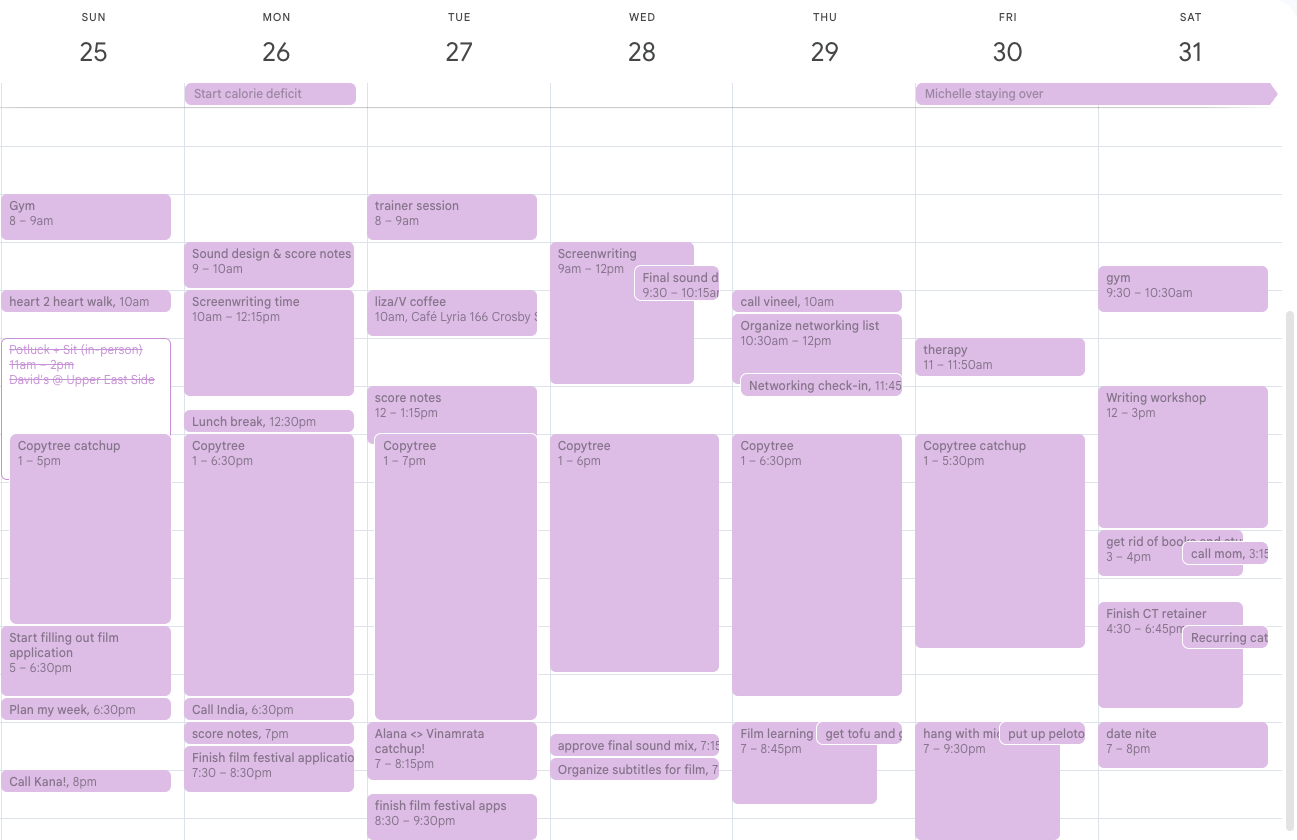
But underneath this well-organized calendar is a hidden truth: Most weeks, keeping this schedule makes me feel so tired. I’m starting to feel like life is a checklist, and while yes, it feels good to check things off the list, is that all that I am?
Story time
In my 20s, whenever I felt tired or low on energy, I interpreted it as a sign that I just needed to push harder, whether by staying up later or eliminating “distractions” (e.g., socialization) to get more stuff done. It totally worked: I got through difficult CS classes, added more extracurriculars to my plate in college, and took a similar approach in the workplace. It’s what allowed me to succeed at Google and take on roles with bigger scope throughout my product career.
But at some point, the exhaustion catches up to you. You feel less energized, the world seems a little grayer, and little things get to you more than you’d like. In those moments, it’s even more important to slow down, but the only thing that seems possible is to speed up even more. So we work harder, giving every ounce of energy we have left, until we’re running on empty.

I experienced this phenomenon the most during COVID, where I regularly worked 60 hours a week at Propel. Part of the reason was that there wasn’t much going on in my personal life, since I was trapped at home and didn’t have any real hobbies or outlets. I got a lot of positive validation at work, and we were doing meaningful work, so hey, it seems reasonable to keep going. But the impact on my body was obvious: body aches, poor posture, and mental fogginess that only got worse with time.
I thought I was a warrior for pushing through, but I was really just delaying the inevitable.
Reset with the sabbatical
My sabbatical was the first time I really interrogated whether more work was necessarily better.
I spent days meandering, going for walks, reading, and thinking. But the discomfort of not being productive was hard for me, so I spent a lot of time working on projects that went nowhere. No matter what I did, I felt restless, tired, and behind. I felt stuck in this cognitive dissonance: working so hard yet making so little progress during a time that was supposed to be restorative and rejuvenating. And that’s when it really hit me:
If I work so hard and I don’t even get to enjoy it, then what’s the point?
That’s when I started paying attention to the moments that actually felt good, not the moments that should feel good. I realized I do need to make progress, but I can’t let my work take over my life. It was a lesson that I had been told repeatedly in my product career, but now was the first time that I was willing to actually acknowledge it.
Relearning the lesson, again and again and again
I’d love to say that after this one moment, I had perfect boundaries with my work. But nope, I burned myself a year later, overworking on After Moonrise, my directorial debut. I didn’t give myself the rest or compassion I needed throughout the process, which led to said burnout.
And then oops, I did it again. In January of this year, while I was in post on After Moonrise, I set an ambitious goal of finishing a draft of my next short because, well, I wanted to make the next film this year. Why? Because you can take the girl out of corporate, but you can’t take corporate out of the girl.
All jokes aside, I’m grateful for the friends who stepped in and were like, girl, what are you doing? You need to celebrate! Take a break! And I’m so glad they said something, because I was too locked in and felt like if I didn’t hit this deadline, my career would be over before it started.
I had lost the plot.
After taking a week off, I realized:
What was I thinking?
There’s a ton of other things on my plate (moving, distribution for After Moonrise) that will need more of my attention (and this isn’t a shortcoming on my part).
What was I thinking????
Most importantly, how this process feels matters just as much as the end result—and accepting this means progress is slow and nonlinear.
So now, I have this sticky note prominently on my desk:
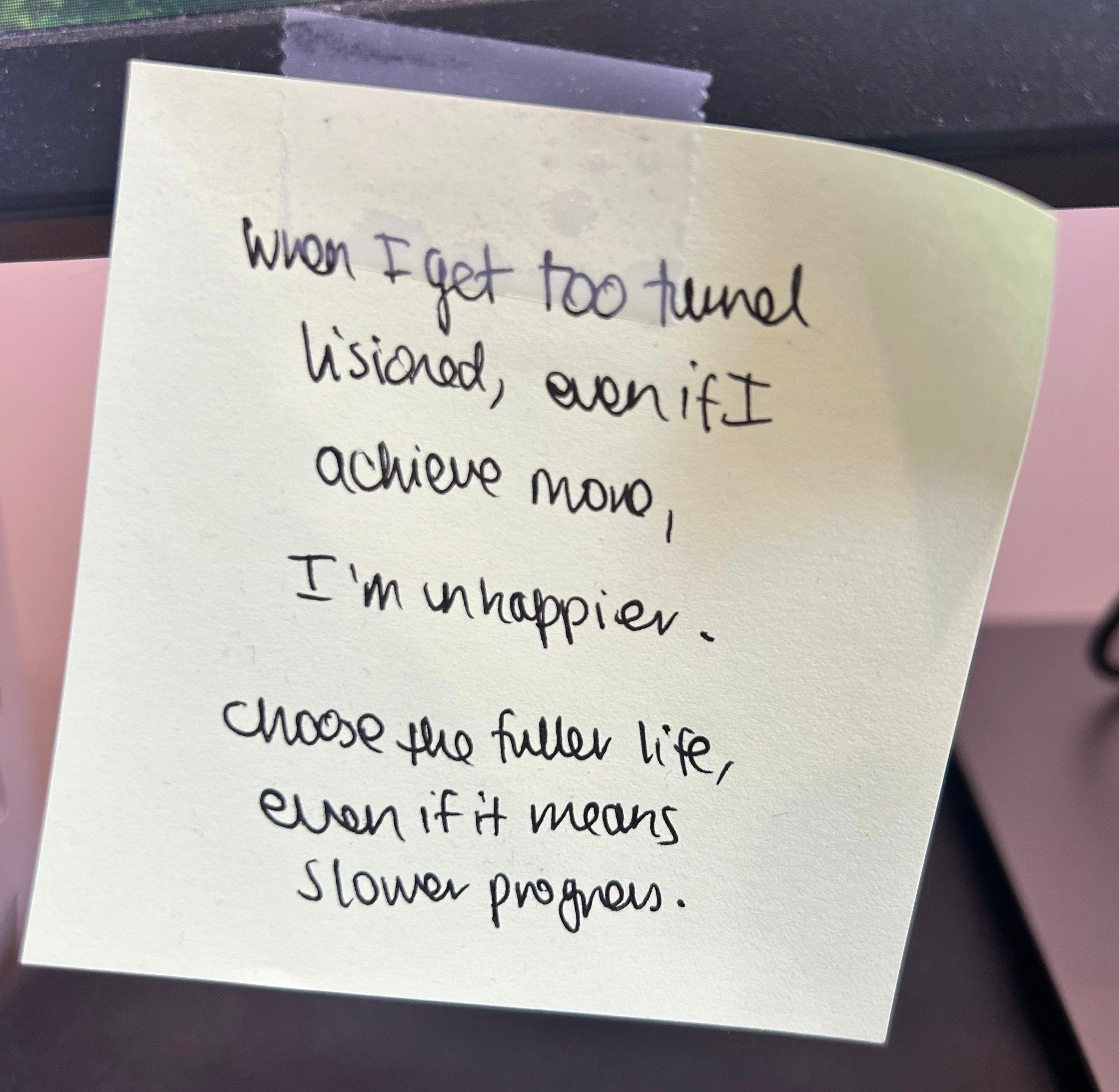
Accepting slow progress
Locking in is detrimental to my mental health, but it also gives me a sense of control over my life. It makes me feel as if my destiny is in my own hands, even though, frankly, it’s not—progress is about luck, timing, and persistence.
Letting go of this belief requires accepting that progress is non-linear, which means surrendering control. As someone who grew up in an incredibly chaotic household, I find the idea of losing control incredibly scary and overwhelming.
But I’m taking baby steps. I’m starting to view tiredness as a sign that something needs to give, and actively deprioritizing tasks (even if it makes me feel incredibly uncomfortable). I’m using my calendar skills to my advantage by scheduling blocks of time for rest, and so far I’ve been pretty good at respecting them! And if I fail and lock in anyway, I give myself grace and time to recover rather than chastising myself.
Locking in isn’t bad—but it has its time and place.
Thanks for reading!
I’m a former tech product manager turned technical writer/filmmaker. In this newsletter, I share more about my journey of chasing my writing/directing dreams while working part-time in tech, growing a family, and trying not to let achievement define my self-worth in the process. Here are some ways to support my work:
Heart this post if you resonated with the content.
Hearing from readers also gives me a ton of energy. Drop a comment if you’ve struggled with your relationship to locking in.
And if you haven’t subscribed already… consider joining the club! I post 1-2 times a month about topics like navigating my creative career, reflections on my product career, and my journey of accepting who I really am rather than who I’m validated for.
Whenever I think hustle culture is out of my DNA, I realize it’s not. So relatable and happy to hear you did give yourself a break this year. You not only deserve it, it’s necessary too.